
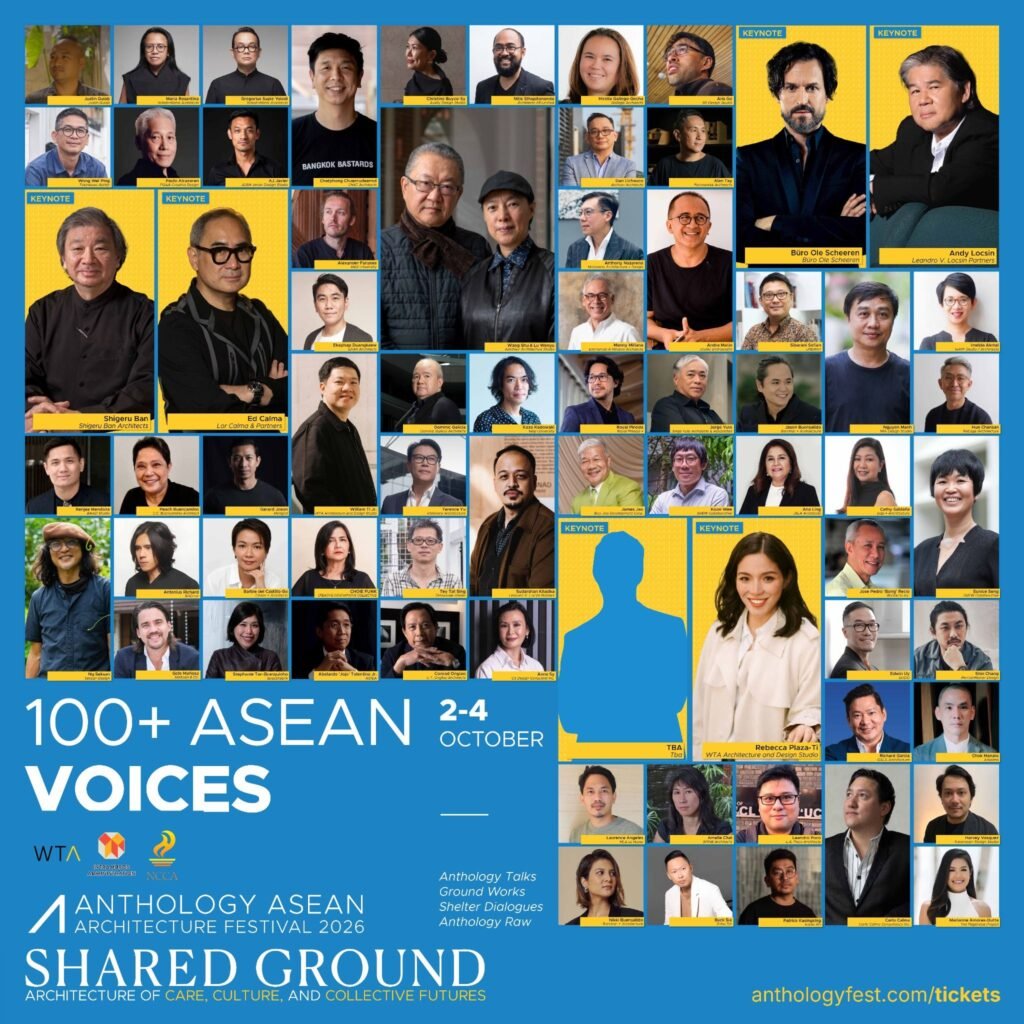
Hosted in Manila’s historic Intramuros during the Philippines’ ASEAN 2026 hosting, the three-day festival will convene 128 speakers—including Shigeru Ban and Ole Scheeren—alongside ten Filipino × ASEAN installations, regional dialogues and public forums.
Anthology ASEAN Architecture Festival 2026 will put the Southeast Asian nation at the centre of this year’s architecture and design conversation. Taking place on October 2–4, 2026, at Intramuros, Manila, the festival will bring together architects, designers, cultural practitioners, government leaders, institutions, students, communities and the public under the theme “Shared Ground: Architecture of Care, Culture, and Collective Futures.”
Organized by WTA Architecture & Design Studio in partnership with the City of Manila, Intramuros Administration, and National Commission for Culture and the Arts (NCCA), this year’s Anthology Festival is envisioned to be a significant industry, civic and cultural event—one that connects architecture and design with heritage, public life, governance and the future of Southeast Asian cities. The festival is supported by main sponsors Boysen, Fasclad, Glassbox, Omni and Midea.
With 128 speakers from the Philippines, Singapore, Indonesia, Thailand, Vietnam, Cambodia and beyond, Anthology 2026 will feature three international keynotes, 14 Filipino × ASEAN conversations, cross-sector roundtables, ten regional installations, open presentations and evening forums, with an expected audience of 4,000.
“Anthology is making ASEAN the starting point for this edition—not simply as a geographic category, but as a field of shared conditions, ideas and possibilities,” says William Ti Jr., festival curator and founder and principal architect of WTA Architecture and Design Studio. “Shared Ground asks what we can learn from one another while respecting what makes each city and community distinct.”
Since 2016, Anthology has held seven editions, welcomed more than 20,000 participants and brought together 455 speakers from the Philippines and around the world. This year’s regional focus marks a new chapter for the festival, expanding its role as a platform for Southeast Asian exchange and thought leadership.
Shared Ground: Architecture for a Region in Transition
“Shared Ground” reflects the belief that architecture is more than buildings. It is also about how people live together, how public spaces are shaped, how communities respond to climate and change, and how culture and memory are carried into the future.
The festival will explore three interconnected ideas over three days. Each day connects one of the festival’s themes to a defining question and an international keynote.
October 2 — Care: What is owed to a building and its people after ribbon-cutting?
Pritzker Prize laureate Shigeru Ban will open the festival with a keynote on Care. His humanitarian work with paper structures, temporary buildings and disaster-relief housing demonstrates how emergency architecture can be innovative, dignified, resource-conscious and rigorous.
The discussion will connect to the Philippines’ own experience with emergency architecture. In 2020, WTA delivered 75 quarantine facilities with more than 3,500 beds, raising questions about how architecture can respond quickly without sacrificing dignity—and what responsibility remains after a crisis.
October 3 — Culture: How can architecture hold shared memory without fixing it into a static image?
The keynote for Culture will be announced in the coming days.
The day offers a timely lens for considering heritage and public life in Intramuros, where preservation, identity, tourism, everyday use and urban change exist in constant conversation.
October 4 — Collective Futures: How do we negotiate the futures of our cities across differing needs and finite resources?
Ole Scheeren will close the festival with a keynote on Collective Futures. Through his work across Asia, Scheeren has explored density as a social condition to be designed, demonstrating how large-scale buildings can support community and shared life—not merely accommodate floor area.
For a region urbanising at extraordinary speed, the closing conversation will examine how cities can grow while remaining inclusive, connected and collectively shaped.
“At the heart of Anthology 2026 is the belief that “buildings only become architecture once they are shared.” A building becomes architecture through the lives that unfold in it, the communities that use it and the public life it supports,” says Ti.
ASEAN Designing Its Own Future
Anthology 2026 does not propose a single Southeast Asian model. Manila is not Jakarta; Bangkok is not Singapore. ASEAN cities have different histories, climates, economies, cultures and needs.
Instead, the festival will create a platform for the region to learn from itself while remaining grounded in the specificity of each place. Government and public-sector participation is expected to represent approximately 15 percent of the audience, bringing policy, governance and the public interest into direct conversation with design and development.
“We are not looking for one imported answer to the future city,” says Ti. “The region is already generating its own knowledge and models. Anthology is a place to make those ideas visible, put them into conversation and ask what we can build together.”
Intramuros as Shared Ground
For this edition, Intramuros will serve as more than the festival venue. The 400-year-old walled city will become a protagonist in the program, with talks, installations, roundtables and evening forums unfolding across its historic spaces.
Audiences will encounter questions of memory, access, material, public space and collective life while moving through a living urban environment where heritage and change meet.
“We want the festival to leave the conference hall,” says Ti. “In Intramuros, the city itself becomes part of the discussion. It is not a backdrop; it is shared ground.”
The program will include:
- Anthology Talks: Fourteen Filipino × ASEAN conversations on themes including Culture is not a Style, Architecture Without Heroes and Care Without Control.
- Shelter Dialogues: Roundtables pairing an ASEAN architect, a Filipino architect and a government leader in sessions such as Public Good, Private Power and Governing the Future We Share.
- Ground Works: Ten Filipino × ASEAN collaborations installed throughout Intramuros, including Thresholds of Access, Material Memory and Local is Future.
- Anthology RAW: An open platform for emerging work, unfinished ideas, new research and perspectives, with moderated critics responding to each presentation.
- Living Anthology Exhibition: A living exhibition showing the evolving positions on Shared Ground throughout the course of the festival, on view until December at the Centro de Turismo Intramuros.
- After Dark: Evening forums bringing architecture into conversation with culture, history and public life after sunset.
- Publications: WTA Shared Ground Artbook, narrated by Potato, the studio cat, explores eleven WTA projects in a playful and accessible way. Field Notes is a post-festival publication documenting the ideas and moments collected from the festival.
Anthology ASEAN Architectural Festival 2026 is designed for architects and designers, but it is equally an invitation to students, artists, educators, cultural workers, policymakers, developers, communities and anyone invested in the future of cities. For the full program and registration details, visit anthologyfest.com.